

Strategic Insights from World Tour and SPN Connect 2025
Snowflake AI in Practice
03.08.2026

Software Engineer

Partner Sales Manager
Introduction
The data landscape is changing rapidly. What used to be a race to centralize data in cloud warehouses has now become a competition for intelligence, automation, and real-time decision-making.
At two recent Snowflake events—SPN Connect Day (Berlin, September 30) and the Snowflake World Tour (Berlin, October 1)—one message stood out clearly: Snowflake no longer sees itself merely as a data warehouse, but as an integrated platform for AI and data analytics.
For companies in regulated industries such as healthcare, life sciences, media, and logistics, this shift marks a crucial step toward future-proof, data-driven system landscapes. It opens up new possibilities but also requires a critical assessment of maturity and governance. With new features such as Snowflake Intelligence, AISQL (AI-powered SQL), and Cortex, the question is no longer about the hype, but about the actual added value: How can these technologies be used responsibly and in a measurable way today?
In this summary, we present key announcements, concrete use cases, and strategic insights from both events—with a clear focus on what truly matters to companies, data teams, and decision-makers.
Snowflake's AI-Centric Strategy: From Data Storage to Intelligent Automation
The Big Shift: Snowflake as an AI Data Cloud Rather Than Just a Data Warehouse.
Snowflake was originally positioned as a “Data Sharehouse” and became known for its scalable, cloud-based architecture with powerful data sharing capabilities.
In 2025, however, Snowflake is pursuing a new direction: a unified AI and data platform that integrates the following components:
Natural language queries (Snowflake Intelligence)
AI-powered SQL extensions (AISQL operators such as AI_FILTER or intelligent JOINs)
Autonomous data agents for automation, governance, and workflow control
Complete management of the ML lifecycle (Cortex, fine-tuning of LLMs, Data Science Agent)
At SPN Connect Day, Snowflake emphasized three strategic pillars in particular for the German market:
AI-driven democratization of data (access even for non-technical users)
Industry-specific solutions (e.g., for healthcare, life sciences, media)
Partner-centric ecosystem (increasingly widespread: dbt, Dataiku, Coalesce, Microsoft)
Snowflake Intelligence: A Perspective from the Business Units
A live demo of Snowflake Intelligence (currently in public preview) was the main highlight of SPN Connect Day. Snowflake presented the feature as a ChatGPT-like interface that can access enterprise data directly—an impressive concept, though its actual value depends heavily on data quality, governance, and integration with existing systems.
There is far more to this interface than just an interactive chatbot. The following features illustrate the strategic potential of Snowflake Intelligence for enterprise use.
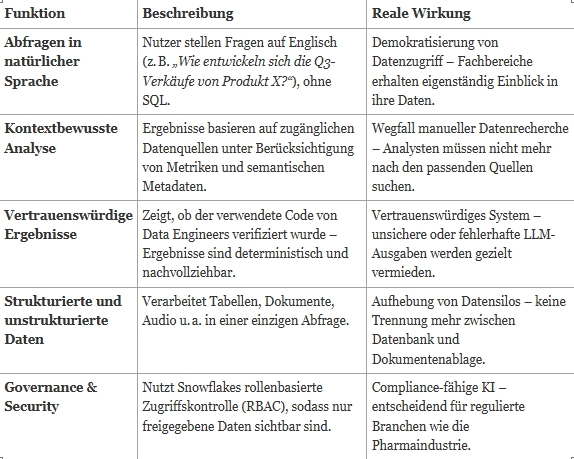
Industry Focus: Where Snowflake's AI Is Making a Real Impact
Snowflake’s AI capabilities demonstrate their potential particularly in areas where data quality, traceability, and regulatory requirements play a central role. A look at regulated industries illustrates how technology can be used responsibly and effectively.
Healthcare and Life Sciences: From Compliance to Drug Discovery
Why this topic is particularly relevant in 2025:
- One of the fastest-growing industries—alongside media and entertainment
- Strict regulatory requirements (e.g., GxP, HIPAA, GDPR) demand traceable and secure data flows
- AI-powered drug development and personalized medicine require scalable, unified data platforms
Case studies from the Snowflake World Tour
- GxP-compliant data pipeline at Merck (in collaboration with Infomotion)
- Challenge: Research and development generate large volumes of structured data (e.g., clinical trials) and unstructured data (e.g., scientific publications, regulatory submissions). Integrating this data in a scalable manner while ensuring GxP compliance for AI applications is a complex task.
- Solution:
- Direct data sharing via the Snowflake Marketplace to avoid ETL bottlenecks
- Four clearly separated Snowflake environments (development, testing, validation, production) enable reproducible validation
- Leveraging Snowflake’s scalability, governance capabilities, and self-service options
- Result: Faster regulatory submissions and reduced validation effort
- AI-powered data harmonization at Boehringer Ingelheim (using Cortex)
- Challenge: Global pharmaceutical companies work with multilingual documents, inconsistent terminology, and sensitive personally identifiable information (PII). These challenges hinder consistent data analysis and automation.
- Solution:
- Use of Cortex LLMs to standardize terms—e.g., by translating them into a unified ontology
- AI-powered removal of sensitive data (PII) while simultaneously summarizing document content
- Cost efficiency through targeted use of LLMs exclusively for master data creation, not for bulk processing
- Result: Global harmonization and standardization of data as the foundation for advanced analytics
Media & Entertainment: From Analysis to AI-Generated Content
Why this topic is relevant:
- Streaming, gaming, and ad tech generate large amounts of unstructured data—such as video metadata or user interactions
- Personalization at scale requires a combination of real-time analytics and AI
Case Study: Data Access at REWE International (jö Bonus Club)
- Challenge: Selecting suitable and high-performing target groups for CRM initiatives often requires manual, time-consuming coordination between different teams.
- Solution:
- Use of Snowpark and Streamlit to develop a no-code CRM application
- dbt ensures traceable data flows and governance through standardized data products
- Real-time feedback: Parameters can be adjusted and recalculated immediately
- Result: Streamlined workflow, shorter turnaround times, ensured data quality, and scalable self-service capabilities for business units
An Important Insight for HMS and Its Partners
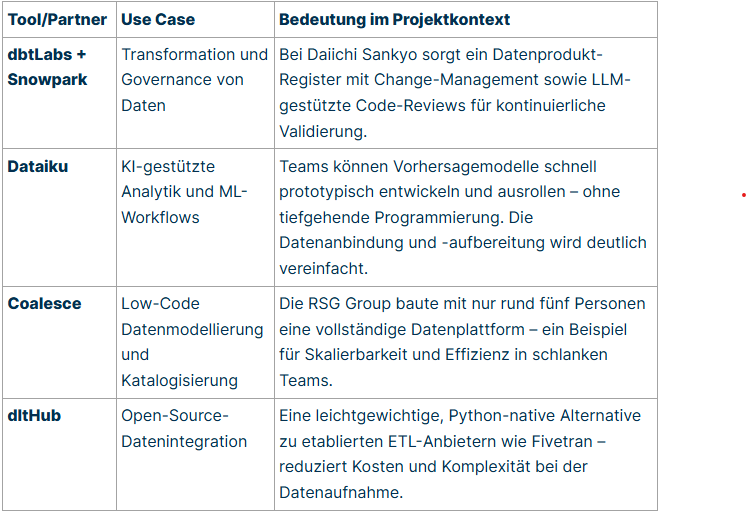
The adoption of dbtLabs—one of our strategic partners—is growing noticeably. Many customers rely on its strong governance capabilities and ease of implementation for their transformation projects.
Other solutions, such as Coalesce and Datavault Builder, are increasingly establishing themselves as low-code alternatives for data platforms in the pharmaceutical sector.
Hosting applications directly on Snowflake—for example, using Streamlit—improves collaboration across departments and specifically supports self-service usage.
Partner Ecosystem: Who Will Benefit Most from Snowflake in 2025?
The “Partner-First” strategy was a central theme at both events. In this context, we held numerous discussions with our partners as well as other Snowflake technology partners. Here are a few examples worth highlighting:
Outlook: Three Key Areas of Focus for Companies
- Test Snowflake's AI features for your own use cases.
- Healthcare / Life Sciences: Evaluate AISQL for data harmonization and Cortex for document processing
- Media / Entertainment: Test Natural Language Analytics for content analysis and app hosting with Streamlit for lean departmental applications
- Supply Chain: Explore piloting AI agents for automated inventory detection
- Select suitable partner solutions for accelerated yet compliant implementation
- Strict governance and transformation required? → dbt
- Looking for simple data preparation and generative AI prototyping? → Dataiku
- Prefer low-code? → Coalesce
- Looking for cost-efficient ETL processes? → dltHub
- Prepare your organization for the AISQL transition (AI-assisted SQL)
- Train data teams on how to use AI functionalities and understand their impact on existing platforms
- Review data models—even unstructured data (e.g., PDFs, audio, video) will be directly queryable in the future
Conclusion: From Data Storage to Intelligent Automation
The Snowflake World Tour and SPN Connect Day 2025 made it clear: The platform is continuing to evolve—from simple data storage to intelligent, AI-powered automation.
For companies—and for HMS and its partners—this holds significant potential:
In healthcare and the life sciences, AI-powered data processing can accelerate drug discovery.
Media companies can personalize content at scale without compromising on governance.
In the supply chain, operational data is transformed into a self-optimizing network.
The key question is no longer whether these technologies will be used—but how they can be integrated responsibly and at the right pace.
HMS focuses precisely on this: We translate technological potential into validated, compliant, and future-proof architectures—thereby creating measurable added value from data and AI.
Additional Information